
Enrol or update your details to vote by 25 October. Vote early from 26 October. Vote for public housing.
Enrol or update your details to vote by 25 October. Vote early from 26 October. Vote for public housing.
Election Scorecard 2026
Over the past year, people across the country have been standing in solidarity with state housing, talking to their neighbours and communities at markets and running events to call on the government to stop the sell off of state housing and build up public support for state housing. Method: This scorecard is based on questions that people came up with together to cover some key principles for public housing. These questions were asked at political panel events and through email correspondence with political parties. Where there has been no answer, the scorecard has been based on publicly available information as of 21 October 2026. This General Election 2026 we’re asking people to Vote for Public Housing! The stakes have never been higher. All over the country our state homes and land are being sold off, making developers and investors richer, while our neighbours are struggling to afford their rent. The National-ACT-NZ First Coalition Government has announced that they will hike the rents of state and community housing tenants, and have passed Move-On legislation which will displace and punish homeless whānau. Big money from real estate is pouring into the donation pockets of National, ACT and NZ First so that investors and developers can secure their profits and power through the continued sell off of our state housing and the weakening of tenants’ rights. When you vote this election, vote for public housing futures, so that your neighbours, flatmates and family members have access to dignified, secure and truly affordable homes.
Scroll down for more info
Increase Scale
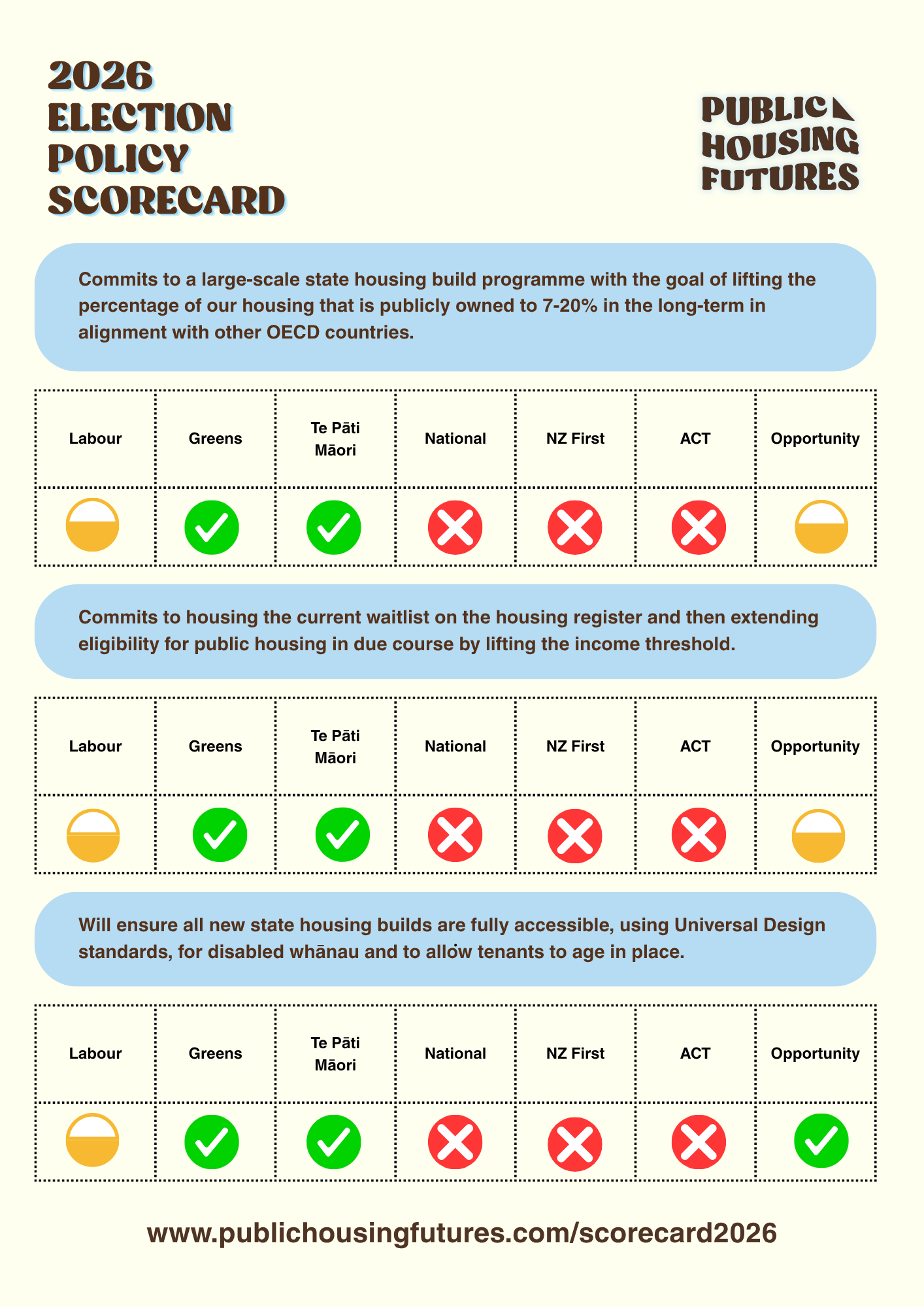
Commits to a large-scale state housing build programme with the goal of lifting the percentage of our housing that is publicly owned to 7-20%* in the long-term in alignment with other OECD countries.
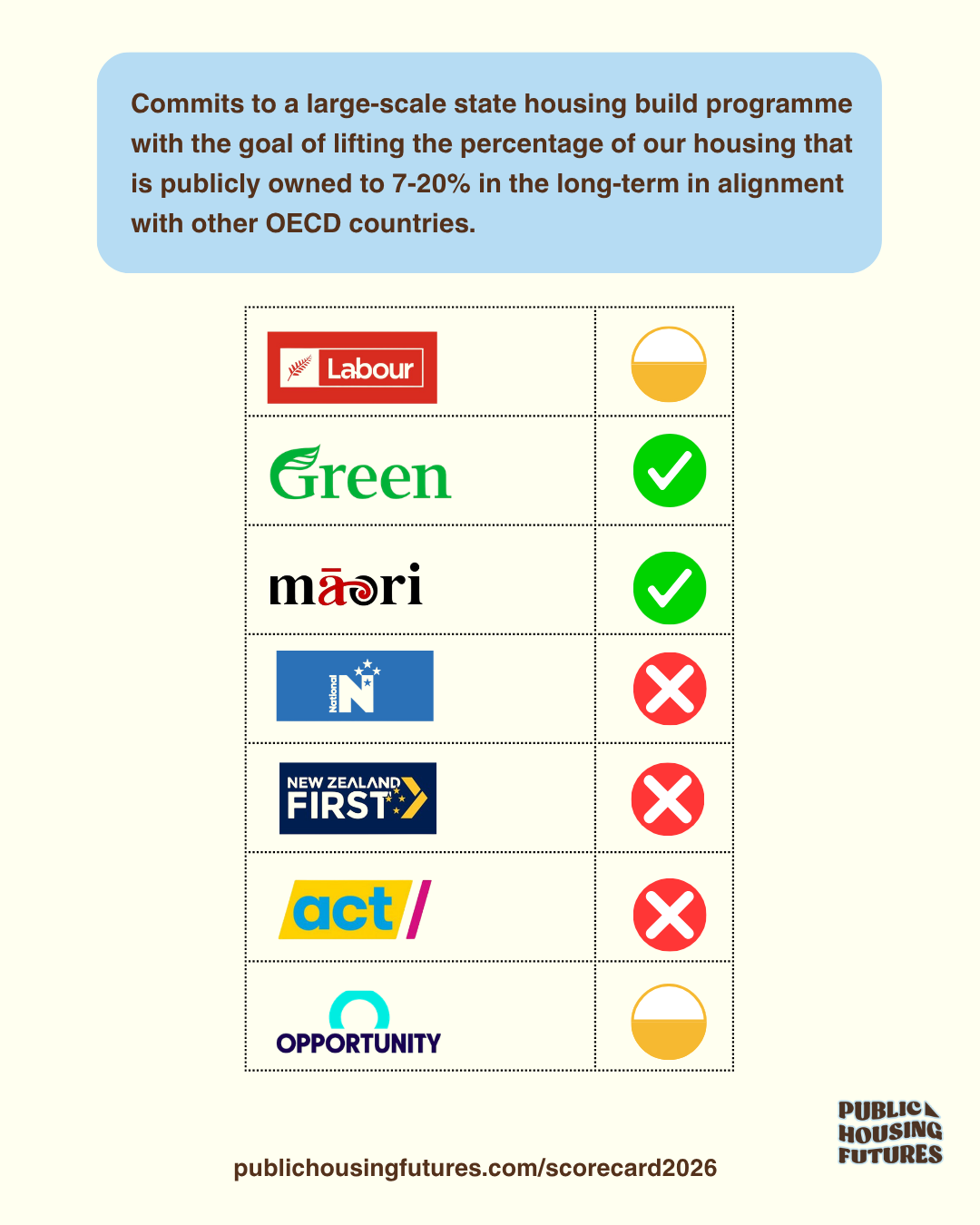
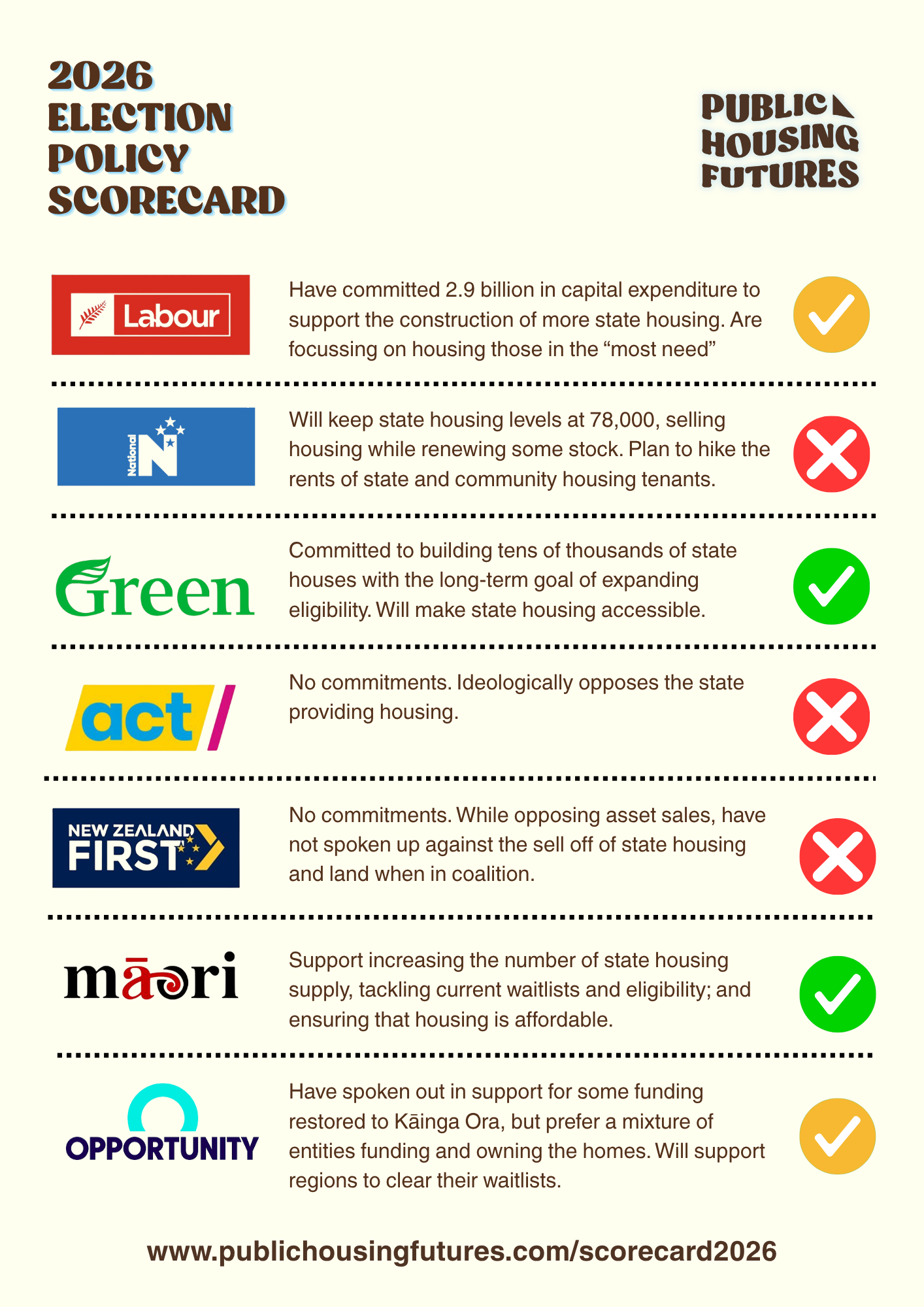
Labour: committed $2.9 billion to build new state housing, to create an additional 6000 homes over 4 years. There has been no commitment yet around a long-term and at-scale build programme. Labour will get Kāinga Ora building again, but also plan to deliver housing through underwriting the community housing sector. 🔗 Policy announcement link
Greens: Confirmed their commitment via email. Plan to build tens of thousands of new public homes. 🔗Policy announcement link
Te Pāti Māori: Confirmed their commitment via email. Has a plan to increase the number of state housing supply. 🔗 Full housing Policy link
National: cancelled 3500 state homes across the country and has plans to sell off 900 state homes a year. Aim to keep publicly-owned Kāinga Ora housing stock at stagnant levels. Any new stock will be "social housing" through certain community providers under a Government backed rents model. Bishop's response via letter correspondence: "Kãinga Ora will continue to renew existing stock, while maintaining a portfolio of around 78,000 homes." See more details 🔗 Kāinga Ora - Turn Around Plan announcement
ACT: No policy or response. Ideologically opposed to the state having a larger role in the construction and provision of housing. Believe the market will build “affordable housing”.
NZ First: No policy or response. While saying they oppose asset sales have sat back and said nothing about the sell off of state housing land.
Opportunity: Partially support this via email correspondence, “Our policy focuses on scaling up affordable and social housing supply by giving councils, Community Housing Providers (CHPs), iwi, and trusted developers direct access to low-cost government finance. We also direct Kāinga Ora to scale up, back to the level they were at prior to this government - approximately 4,000 homes per year." Committed on NZCSS scorecard to increasing "social housing" to 7% to align with other OECD countries. 🔗 see NZCSS housing scorecard
* 7% of all housing stock being “social” or public housing is the OECD average, and 20% would align us with countries who build public housing at scale. 🔗 Check out the OECD info on this.
Expand Eligibility
Commits to housing the current waitlist and then extending eligibility for public housing in due course by lifting the income threshold.
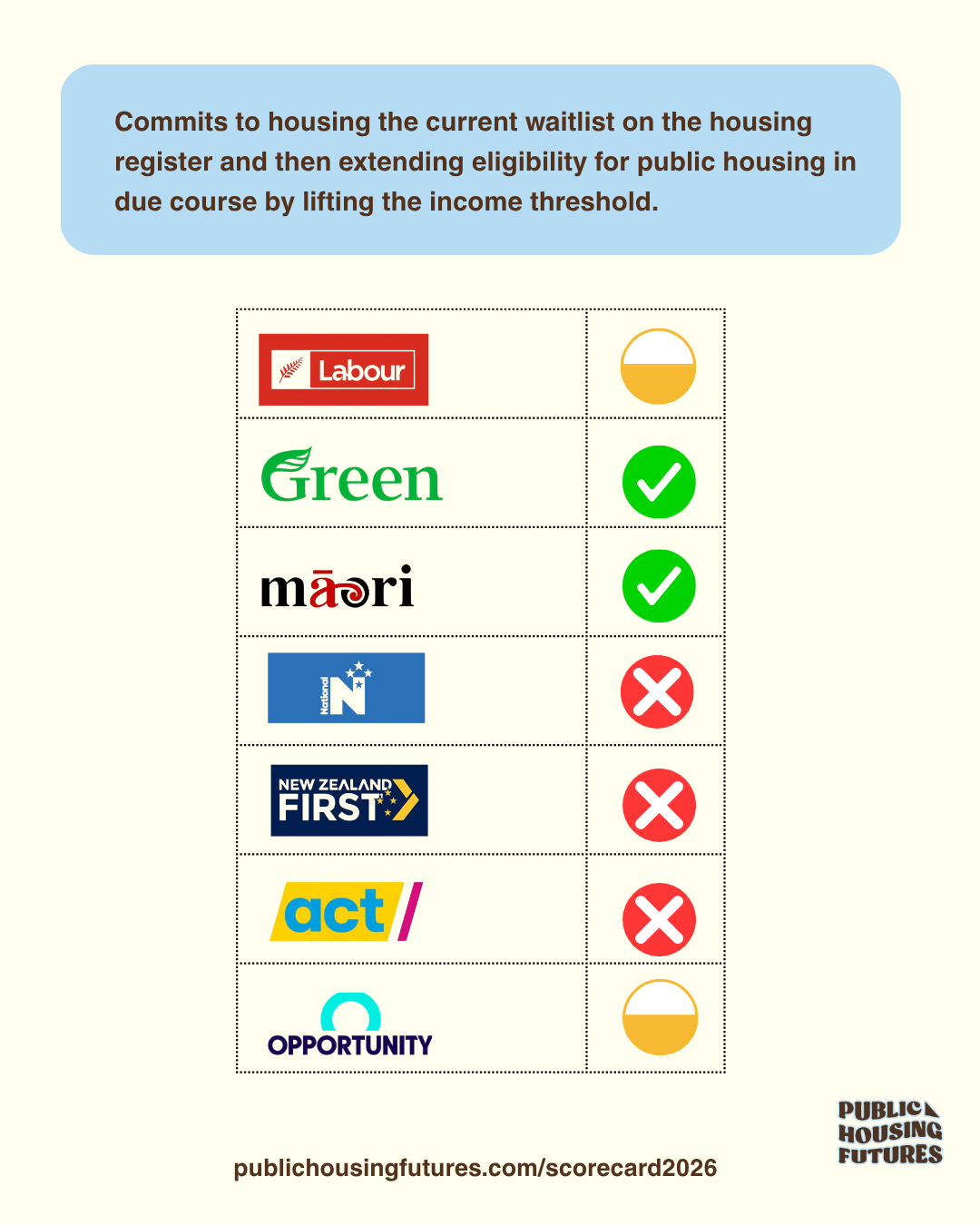
Labour: Answer via email correspondence is: "We share your vision for state housing, however the initial focus will be on those in the most need."
Greens: Confirmed their commitment via email: “Our approach would be to consistently build thousands more public homes each year, and to progressively expand eligibility after the housing register is effectively cleared. This would be a longer-term project to scale up our public housing stock so that public housing is not just the housing of last resort, but a genuine, affordable option for all New Zealanders." 🔗 See their full housing policy.
Te Pāti Māori: Confirmed their commitment via email to tackling current waitlists and eligibility.
National: Chris Bishop has responded via letter correspondence: "I do not support progressively expanding eligibility for public housing to a broader group of renters. My focus is on ensuring support is targeted to those facing the highest levels of housing need.” The Budget 2026 announcement was to "refocus social housing more tightly on those who need it most" and to explore changes to move people from "social housing" into the private rental market. 🔗 News announcement link.
ACT: No response. Have spoken out in support of further targeting and how proud they are of removing the Sustaining Tenancies Framework which has led to more tenants being evicted into homelessness.
NZ First: No response. While seniors are facing a major housing crisis, instead of tackling eligibility for older people, they have announced a policy to limit eligibility of state housing to citizens only.Trying to stoke racist and baseless ideas around who gets privileged access to state housing.
Opportunity: Have partially supported this via email correspondence, "Our policy explicitly directs Kāinga Ora to build the mix of housing that each region actually needs, with the specific goal of enabling smaller towns and regional areas to clear their waitlists. Alongside our Citizens Income policy, a review of the income threshold will be needed.” 🔗 Full housing policy link
Accessibility
Will ensure all new state housing builds are fully accessible, using Universal Design standards, for disabled whānau and to allow tenants to age in place.
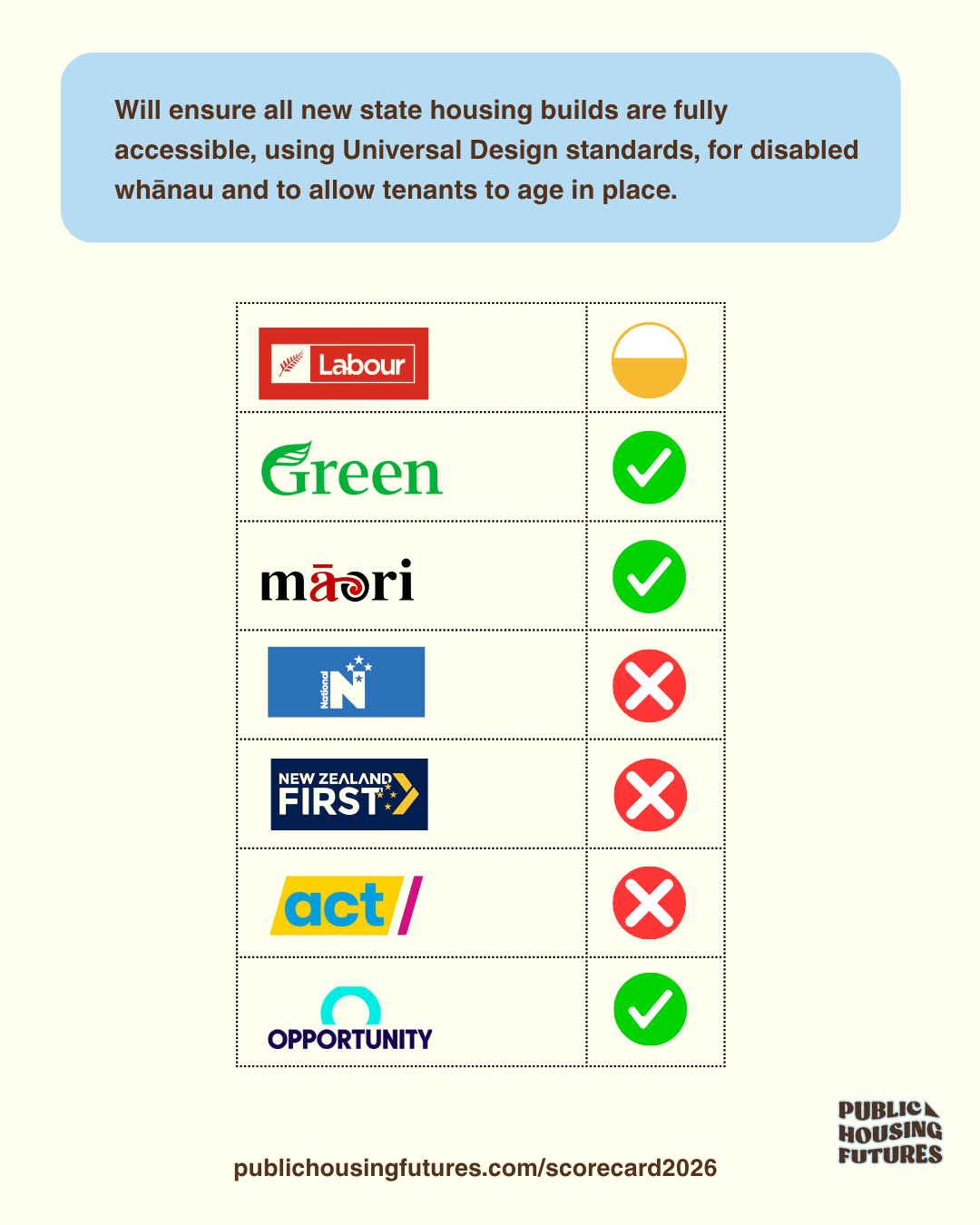
Labour: Have a target of at least 15%. Labour Party Disability Issues spokesperson Priyanca Radhakrishnan said to the D* List that they will increase the target to 25%. 🔗 D* List housing party policy link
Greens: Confirmed support via email.
Te Pāti Māori: via their housing policy, “Te Pāti Māori will ensure that all new government builds are designed to accommodate all whānau, because housing should not discriminate". 🔗 Housing policy link
National: Under National-NZ First-ACT the 15% accessibility targets for Kāinga Ora new builds was removed.
ACT: No policy. As above.
NZ First: No policy. As above.
Opportunity: Confirmed support via email. "Our housing policy focuses on shifting the Building Code from box-ticking to real performance (ensuring homes are warm, healthy, and energy-efficient) and raising minimum standards under the Healthy Homes Standards. We support all new state housing being fully accessible.”
More information on accessibility and housing via D* List: 🔗 housing party policy link
Consistent with Te Tiriti o Waitangi
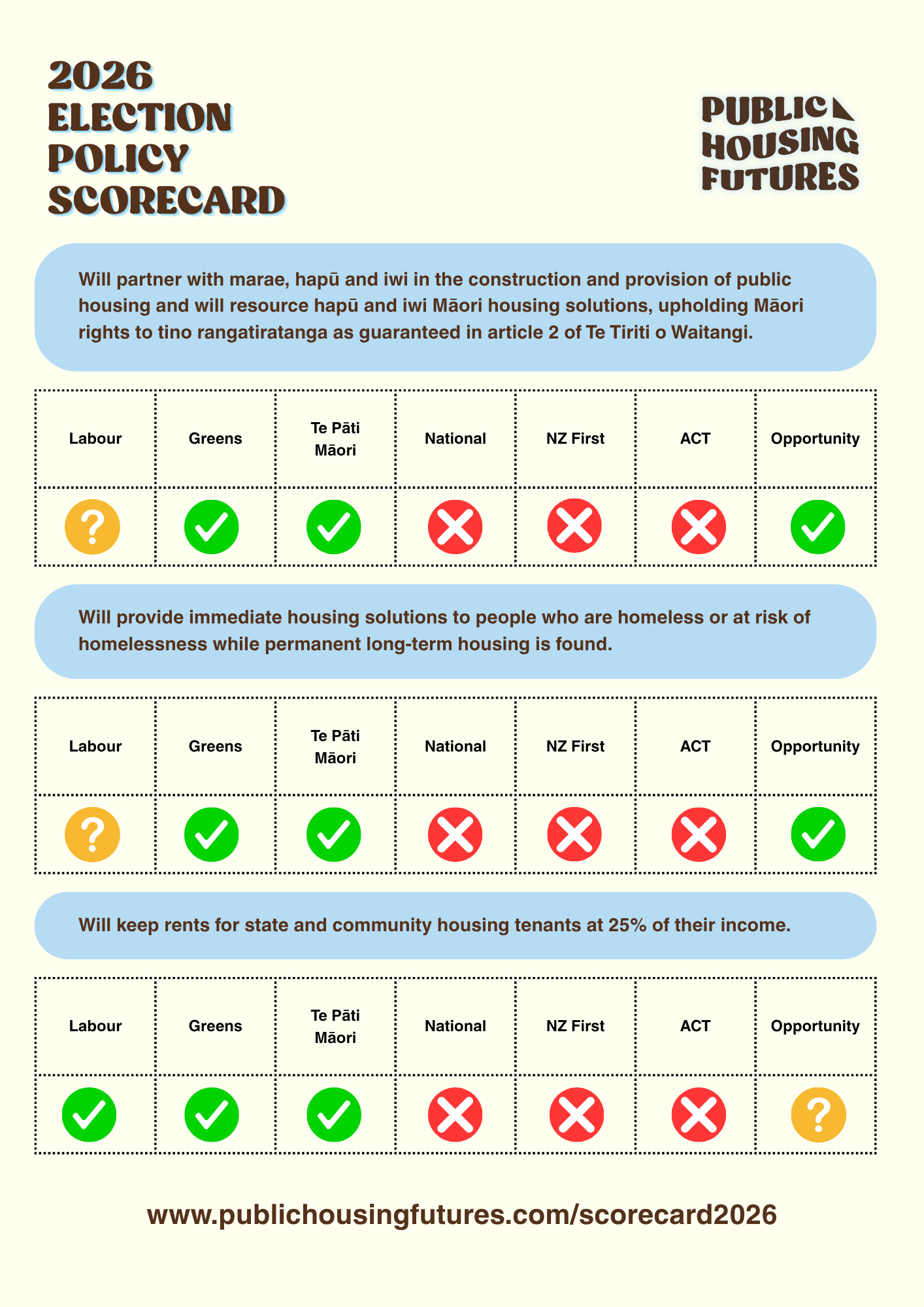
Will partner with marae, hapū and iwi in the construction and provision of public housing and will resource hapū and iwi Māori housing solutions, upholding Māori rights to tino rangatiratanga as guaranteed in article 2 of Te Tiriti o Waitangi.
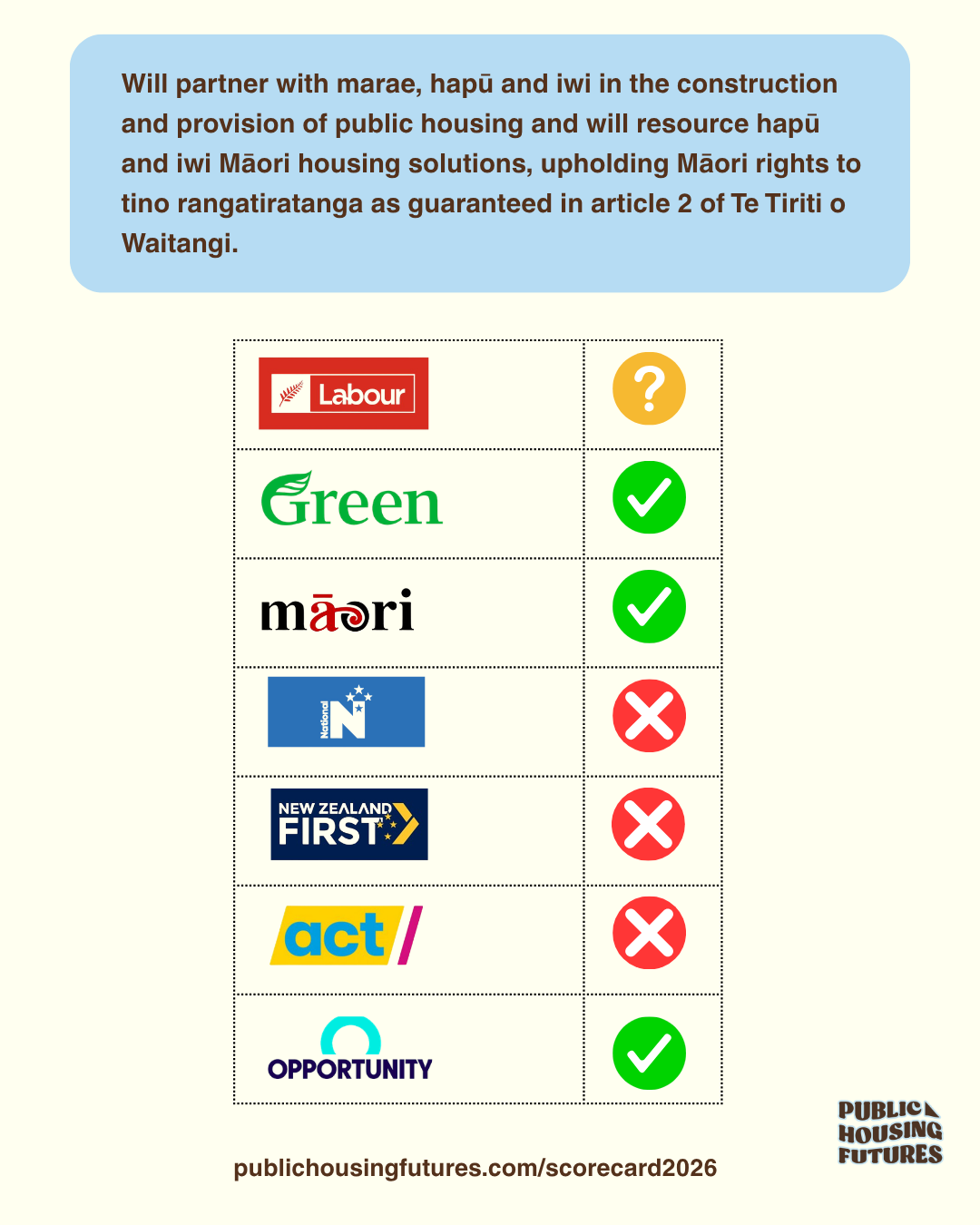
Labour: No policy found but in the past have been supportive of resourcing Māori housing solutions
Greens: Confirmed support via email "Sufficiently resourcing papakāinga and other Māori-led housing solutions and Māori community housing providers." 🔗 Full housing policy link
Te Pāti Māori: via their housing policy "Te Pāti Māori affirms that the Crown has an obligation under Te Tiriti o Waitangi to actively protect Māori housing outcomes and to support whānau-led solutions grounded in whenua, whakapapa, and papakāinga development." 🔗 Housing policy link
National: Under the National-NZ First-ACT Coalition Government has consistently undermined Te Tiriti, aiming to remove it from legislation. They ended the Whai Kāinga Whai Oranga programme.
ACT: No policy. As above.
NZ First: No policy. As above.
Opportunity: Support via email communications "Our Affordable Housing policy explicitly commits to giving iwi direct access to low-cost government finance when delivering social or affordable housing. Furthermore, we commit to updating housing laws to make it faster and easier to build papakāinga and multi-generational housing solutions. This aligns with our broader commitment to honouring Te Tiriti o Waitangi through genuine partnership."
More information on Te Tiriti o Waitangi obligations and housing via Human Rights Foundation 🔗 https://humanrightsfoundation.org.nz/the-right-to-a-decent-home
Immediate housing solutions
Will provide immediate housing solutions to people who are homeless or at risk of homelessness while permanent long-term housing is found.
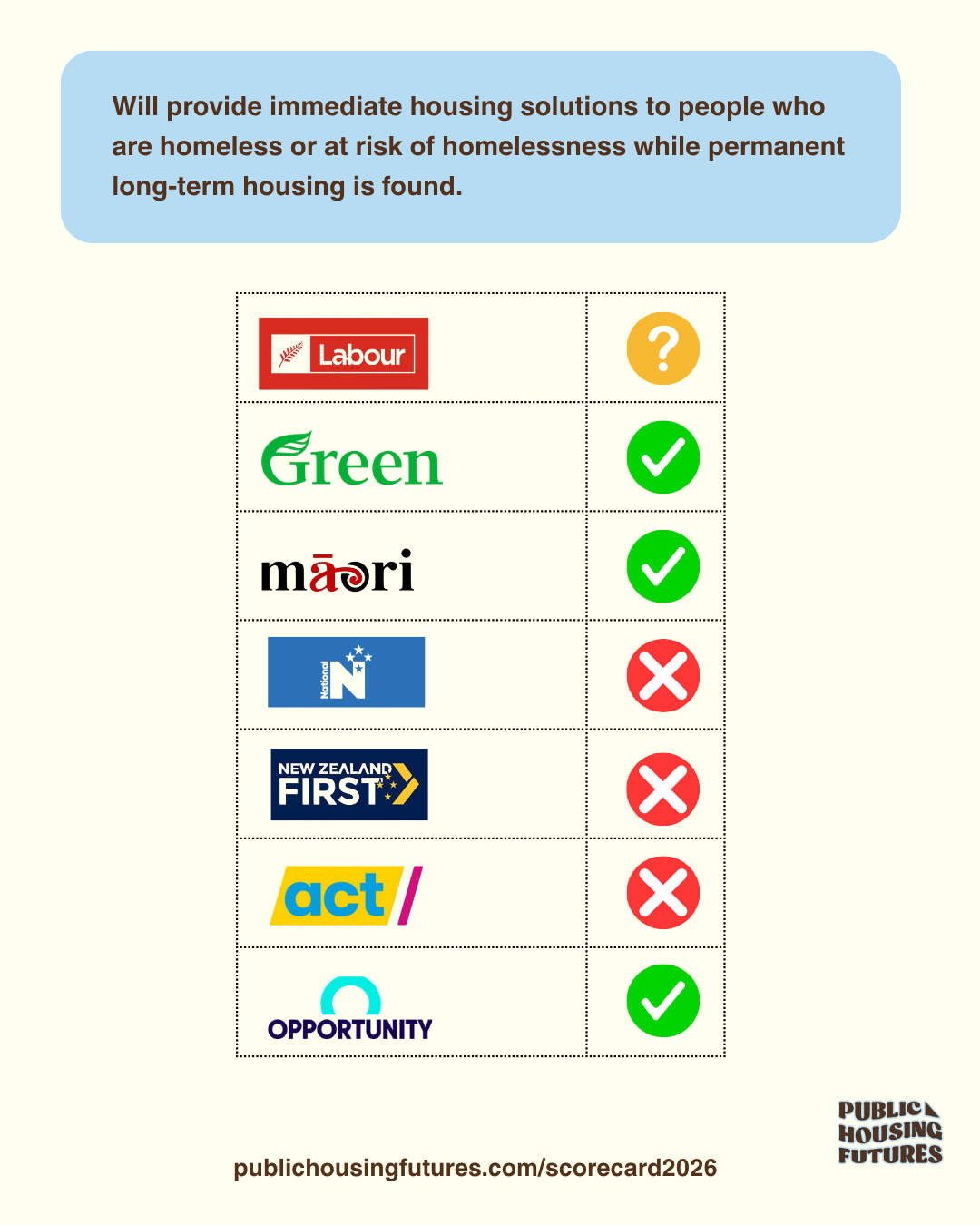
Labour: No policy found but have spoken out against “homelessness” being a part of the Move-On orders legislation, and have said they will reverse the emergency housing changes.
Greens: Confirmed via email. Supports Duty to Assist legislation
Te Pāti Māori: via Housing Policy "Te Pāti Māori will create a legal duty to assist, meaning that government agencies will be required to do everything in their power to end a young person’s homelessness, or to stabilise their housing." 🔗 Housing policy link
National: Under the National-ACT-NZ First Coalition Government, barriers were put up for people to access emergency housing resulting in more people and families becoming homeless. Supported legislation to move on and displace homeless whānau.
ACT: No policy, as above.
NZ First: No policy, as above.
Opportunity: Support via email communications. "Our policies focus on long-term structural changes to house prices, wages, and permanent housing supply through low-cost financing for CHPs/councils/iwi, faster consenting, and Kāinga Ora regional delivery to clear waitlists. We absolutely support housing those most in need, while long-term solutions are found."
Affordability
Will keep rents for state and community housing tenants at 25% of their income
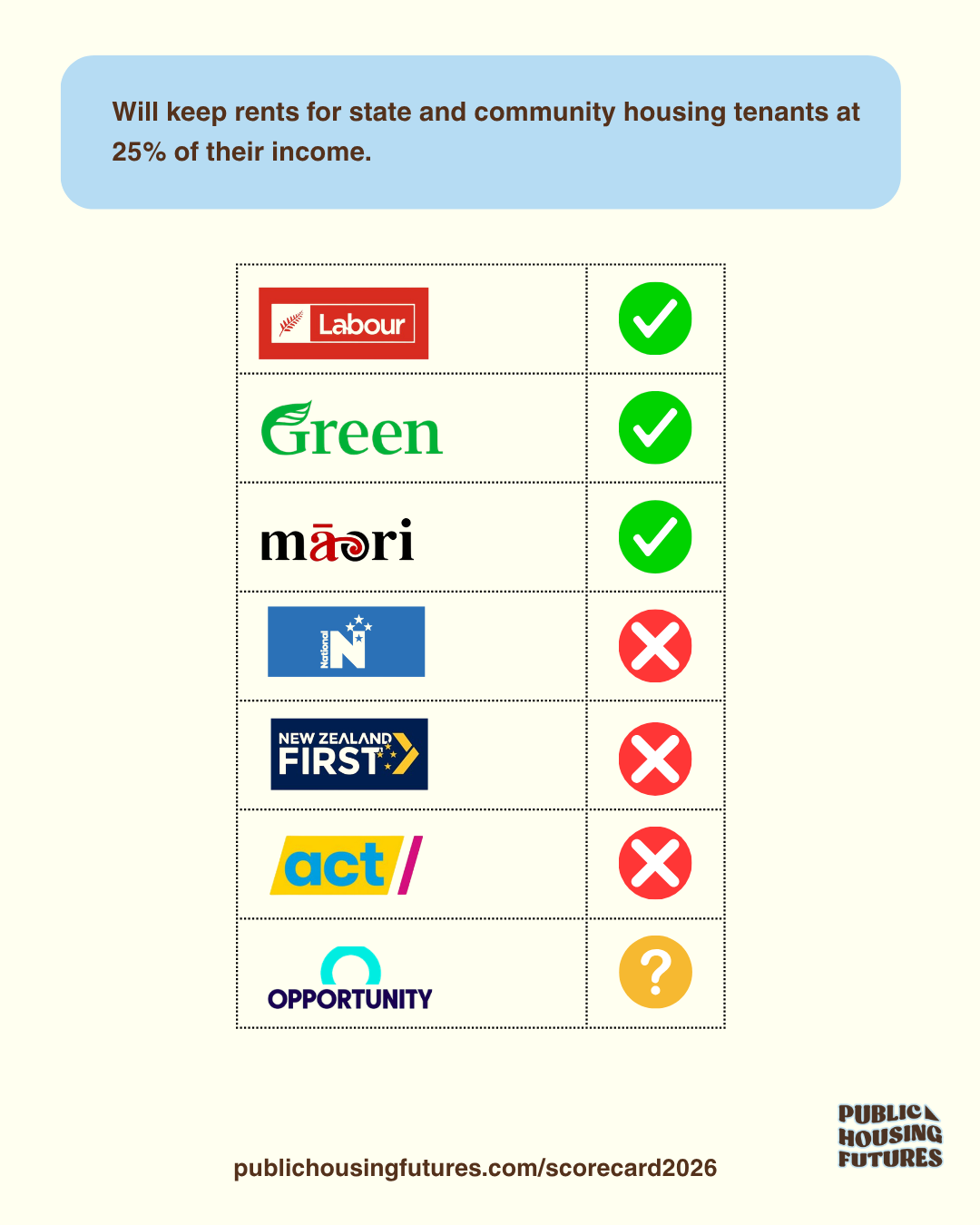
Labour: Confirmed via media 🔗 link to RNZ article
Greens: Confirmed via email correspondence.
Te Pāti Māori: confirmed via email correspondence to keep rents affordable
National: Under the National-ACT-NZ First Coalition Government, an announcement was made before Budget 2026 to increase rents for state and community housing tenants from 25% to 30% of income.
ACT: As above.
NZ First: As above.
Opportunity: No policy response yet.